
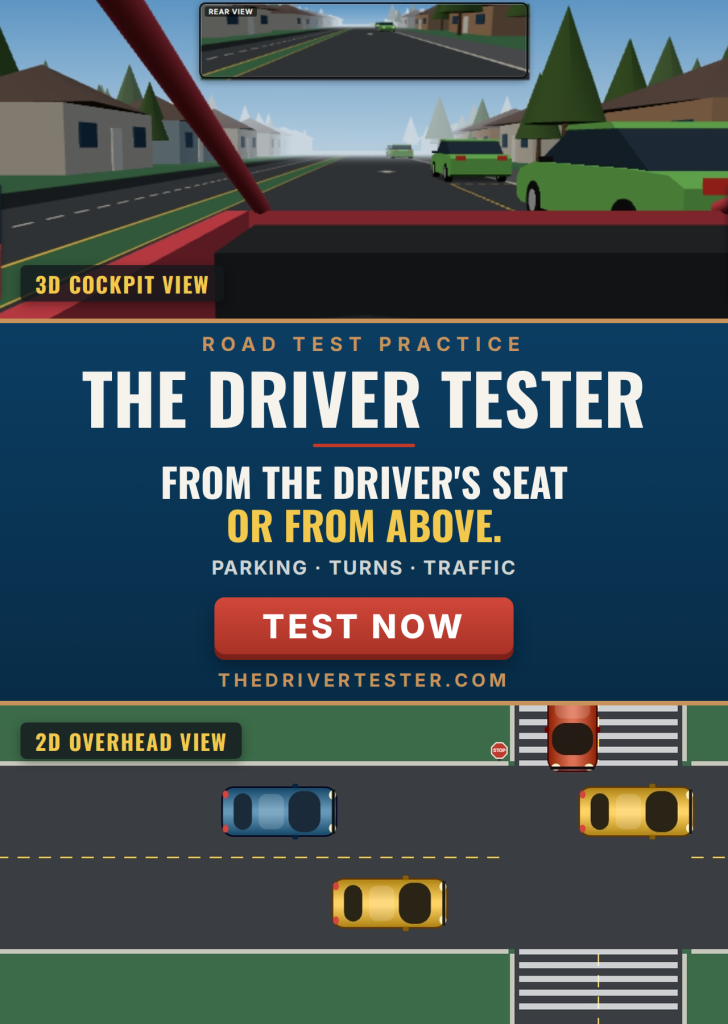
For a lot of new drivers, the road test is the most nerve-racking fifteen minutes of the whole process, and parallel parking is the part they dread most. The Driver Tester is a free browser simulator for practicing the maneuvers an examiner actually grades, as many times as you like, before the day that counts.
What’s new (October 17, 2026): more realistic steering, stricter and more realistic Parallel Parking rules, parked cars and other obstacles that are solid, fairer fault counting, personal bests in every scenario, Replay Last Park and Replay Last Turnaround, and path lines in the 2D view when you reverse. Details below.
Seven scenarios, three vehicles
There are seven scenarios: Parallel Parking, Three-Point Turn, Turns in Traffic, Driving in Traffic, Slippery When Wet, Changing Lanes and Defensive Driving.
Before you drive, pick a Small Car, an SUV or a Small Pickup. Each has its own length, width and wheelbase, so each turns differently, and a bigger vehicle makes the same curbside space noticeably harder to hit.
A real instrument panel
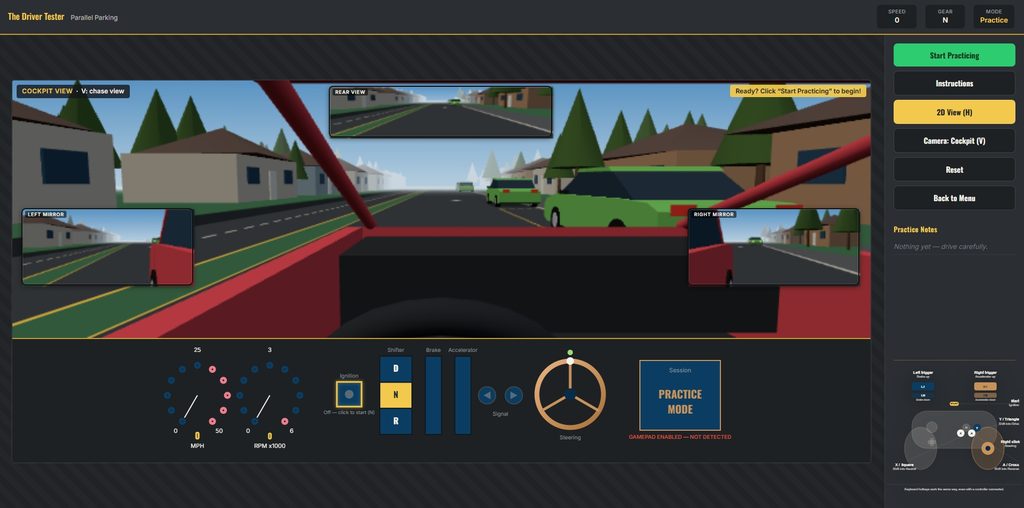
This isn’t a simple go/stop toggle. You start the ignition, let the engine settle at idle, and shift into D, N or R. Try to shift while rolling, or while revving above 1,500 RPM, and the dashboard warns you instead of grinding the gears. The steering wheel is three turns lock-to-lock, and the gas and brake pedals are proportional. Keyboard, mouse and game controllers all work.
The car now steers like a real one. It turns about its rear wheels, so the front swings wide and the rear follows a tighter line inside the turn. That’s the front corner you have to watch when you pull out of a parking space, and the rear wheel that cuts in when you turn into one.
Now You’re Actually in the Driver’s Seat
Every scenario now opens in a full 3D view from behind the wheel, with the same mirrors you’d be checking on a real road test.
- Mirrors that work. A live rear-view mirror sits at the top of the windshield, and both side mirrors show what’s beside and behind you, including a sliver of your own car so you can judge distance the way you would for real.
- A backup camera in Reverse. Shift into R and a backup camera appears on the dash, with guide lines that bend as you turn the wheel to show where the car is headed. It’s a huge help in Parallel Parking and the Three-Point Turn, where knowing which way to turn while backing is half the battle.
- Shoulder checks. Hold A or F to glance out the side windows (it springs back when you let go), or drag the view to look around. Checking your blind spot before a lane change is now something you actually do.
- Your car, your cockpit. The Small Car, SUV, and Small Pickup each get their own cab and seat height, and the steering wheel turns with yours.
- The whole scene in 3D. Parked cars, traffic, stop signs, traffic lights (with the live signal lit), the SLIPPERY signs, the pedestrian, and a braking car’s brake lights all appear in 3D, on the same road you’d see from above.
Press V to switch between the cockpit and a chase camera behind the car, and press H any time to go back to the classic overhead 2D view. On a controller, the View button switches between 3D and 2D, B changes the camera, and the left stick looks around.
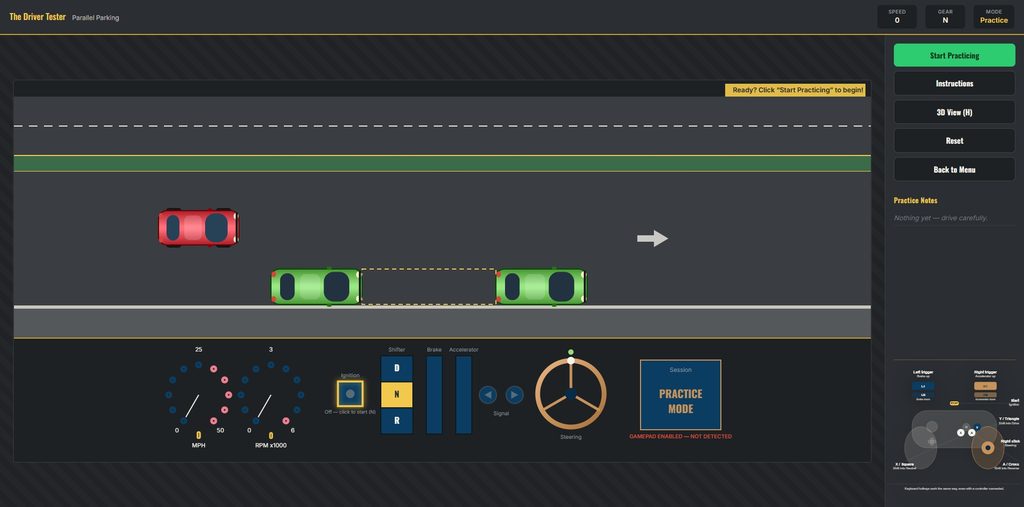
In the 2D view, Parallel Parking and the Three-Point Turn now show colored path lines when you shift into Reverse: green near, then amber, then red, tracing where your rear corners will go with the wheel where it is. They’re the 2D version of the backup camera’s guide lines.
Think you’ve still got it? Pick your vehicle and find out.
How Scoring Works in The Driver Tester
Every scenario in The Driver Tester runs the same way: one continuous five-minute session, and the question is simply how many points can you score before the clock runs out? You need 100 cumulative points to pass, the same threshold in all seven scenarios. One clean maneuver is worth up to 100 points on its own, so a single perfect park passes outright, and several decent ones can add up to it too.
The five-minute clock only starts once you click the start button (Start Practicing, Start Driving, or Start this Turn), so starting the engine and getting settled beforehand doesn’t cost you any time.
The basic idea: faults live, each maneuver scored on the spot
- Faults are taken off the moment they happen and show up in a live fault log.
- Each maneuver is scored automatically when you finish it. There’s no button to press.
- Your live score is the running total of faults and maneuver scores, and it never goes below 0.
- Every scenario uses a four-part breakdown (completion, precision, positioning and efficiency), adapted to that maneuver.
Parallel Parking
Reverse into a curbside space between two parked cars. Each park is scored the moment you’re fully in the space and stopped; pull back out and park again to score again.
A park now only counts if you back in, as on a real road test (pulling in nose-first doesn’t count), and if the whole car ends up between the two ends of the space. Pulling forward a little to straighten up afterwards is fine. To score another park, pull out and back in again.
| Scored on | Points |
|---|---|
| Backed fully into the space (all four corners between its ends), touching nothing | +40 |
| Aligned with the curb (within 8° / 18°) | +20 / +10 |
| Good / acceptable distance from the curb | +20 / +10 |
| 3 or fewer / 5 or fewer direction changes | +20 / +10 |
| Each collision with a parked car | −15 |
| Each curb strike, and each time you leave the roadway | −10 |
Three-Point Turn
Reverse direction on a narrow residential street. It’s deliberately too tight for any vehicle’s turning radius, so you have to reverse at least once. Each turnaround scores the moment you’re facing the other way.
| Scored on | Points |
|---|---|
| Facing roughly the opposite way (within 30° of 180°), back on the road, no faults | +40 |
| Within 8° / 18° of exactly 180° | +20 / +10 |
| Well / reasonably centered, not hugging a curb | +20 / +10 |
| 2 or fewer / 4 or fewer direction changes (2 is a textbook three-point turn) | +20 / +10 |
| Hitting the mailbox | −15 |
| Each curb strike | −10 |
Turns in Traffic
Judge a safe gap in oncoming traffic and turn left at a signalized intersection. Each turn scores the moment you’ve cleared the intersection into the cross street.
| Scored on | Points |
|---|---|
| Facing roughly north (within 30°), in the cross street, no collision, didn’t enter on red | +40 |
| Facing squarely / roughly north (8° / 18°) | +20 / +10 |
| Landed cleanly / reasonably centered in the correct lane | +20 / +10 |
| Gap of 3.0+ / 1.5+ seconds, judged at the centerline | +20 / +10 |
| Colliding with oncoming traffic (sends you back to the start) | −40 |
| Entering on red (also cancels that turn’s +40) | −15 |
| Leaving the roadway | −10 |
Driving in Traffic
A continuous drive rather than a single maneuver: keep your distance and hold your lane. Each lap of the road is scored as you complete it.
| Scored on | Points |
|---|---|
| Lap completed without a serious incident | +40 |
| Centered / mostly steady in your lane, averaged over the lap | +30 / +15 |
| Clean / mostly clean following distance (no tailgating faults / 2 or fewer) | +30 / +15 |
| Colliding with another car (the next lap restarts from the start line) | −40 |
| Hitting the stopped car at the cross-street stop sign | −15 |
| Leaving the roadway | −10 |
| Following too closely (logged periodically while you keep tailgating) | −10 |
Slippery When Wet
The same drive as Driving in Traffic, with the same scoring, on a road with three wet patches that cut your tires’ grip. There’s no separate “wet patch” score: the patches just make it easier to slide off the road, close up on the car ahead, or hit someone, and a clean lap correspondingly harder to bank. Slow down before the SLIPPERY signs.
Changing Lanes
Signal, pick a gap, and move over. Each lane change scores the moment you’ve settled, driving straight again, in the new lane. Change your mind halfway and swing back, and nothing is scored or penalized.
| Scored on | Points |
|---|---|
| Correct signal at least half a second early and a fault-free change / a clean change without a timely signal | +40 / +10 |
| Gap of 3.0+ / 1.5+ seconds in the target lane | +20 / +10 |
| Settled centered / reasonably centered | +20 / +10 |
| Crossed in 1.2 seconds or less / 2.5 seconds or less | +20 / +10 |
| Colliding with a moving car (sends you back to the start) | −40 |
| Hitting the stopped car at the stop sign | −15 |
| Leaving the roadway, following too closely, or lingering over the lane line for more than 3 seconds | −10 |
Defensive Driving
Drive normally, and every 12 to 25 seconds something goes wrong: the car ahead brake-checks you, a pedestrian darts off the shoulder into your lane, or the car at the stop sign pulls out in front of you. Each of these opens a six-second reaction window, and your reaction is scored when it closes.
| Scored on | Points |
|---|---|
| Reacted without a fault / with one | +40 / +15 |
| Safe (3.0+ s) / workable (1.5+ s) following gap when the hazard began | +20 / +10 |
| Peak braking 60% or less / under 90% | +20 / +10 |
| Swerved into a safe / workable gap (+20 if you never left your lane) | +20 / +10 |
| Striking the pedestrian (sends you back to the start) | −80 |
| Colliding with a moving car, including the stop-sign car after it pulls out | −40 |
| Bumping the stop-sign car while it waits | −15 |
| Leaving the roadway or following too closely | −10 |
A couple of things worth knowing
- Staying in contact with something (a curb, a parked car) logs one fault, not one every instant. Touching the same thing again only costs another fault once you’ve been clear of it for half a second, so creeping up against a bumper doesn’t pile up faults.
- Solid things stop you. Parked cars, the mailbox and the stopped car at the cross street are solid now. Touching one costs the fault and stops your car where it was, instead of letting you push through.
- Direction changes are any switch between D and R. Going through Neutral doesn’t hide one: D to N to R counts the same as D to R.
- Collisions are now checked exactly, so two cars meeting corner-to-corner can’t slip through each other.
- Hitting moving traffic doesn’t end the session. It costs points, sends you back to the start line, and voids the maneuver you were in the middle of.
- Running out the clock isn’t a fault. Your total at that moment is your final score.
- Pausing freezes the clock, the traffic and the scoring. Switching to another tab or window pauses the session for you and releases any keys you were holding, so the car can’t keep steering or accelerating while you’re away.
Personal bests and replays
Your best session score and your best single maneuver (park, turnaround, turn, lap, lane change or reaction) are saved for each scenario and vehicle. They’re shown on the result card and on the setup page, and the fault log tells you the moment you beat one. They’re stored only in your own browser.
In Parallel Parking and the Three-Point Turn, a Replay Last Park or Replay Last Turnaround button appears after each scored attempt. It plays the run-up back at double speed in either view, then puts your car back exactly where it was. The clock doesn’t run while it plays, and Esc stops it.
Practice Mode
Want to learn without the pressure? Turn Timer & Scoring off on the setup page for Practice Mode: no clock and no score. Faults and maneuvers still show up in the log as notes, so you can see what you’d have been marked on.
For the real-world side of each maneuver, the guide and the articles cover parallel parking, three-point turns, lane changes, left turns, following distance, wet roads and the most common reasons people fail.
Pick your vehicle, check your mirrors, and see if you’d pass. No download required.
Please email your questions or comments to theboatdocker@gmail.com